

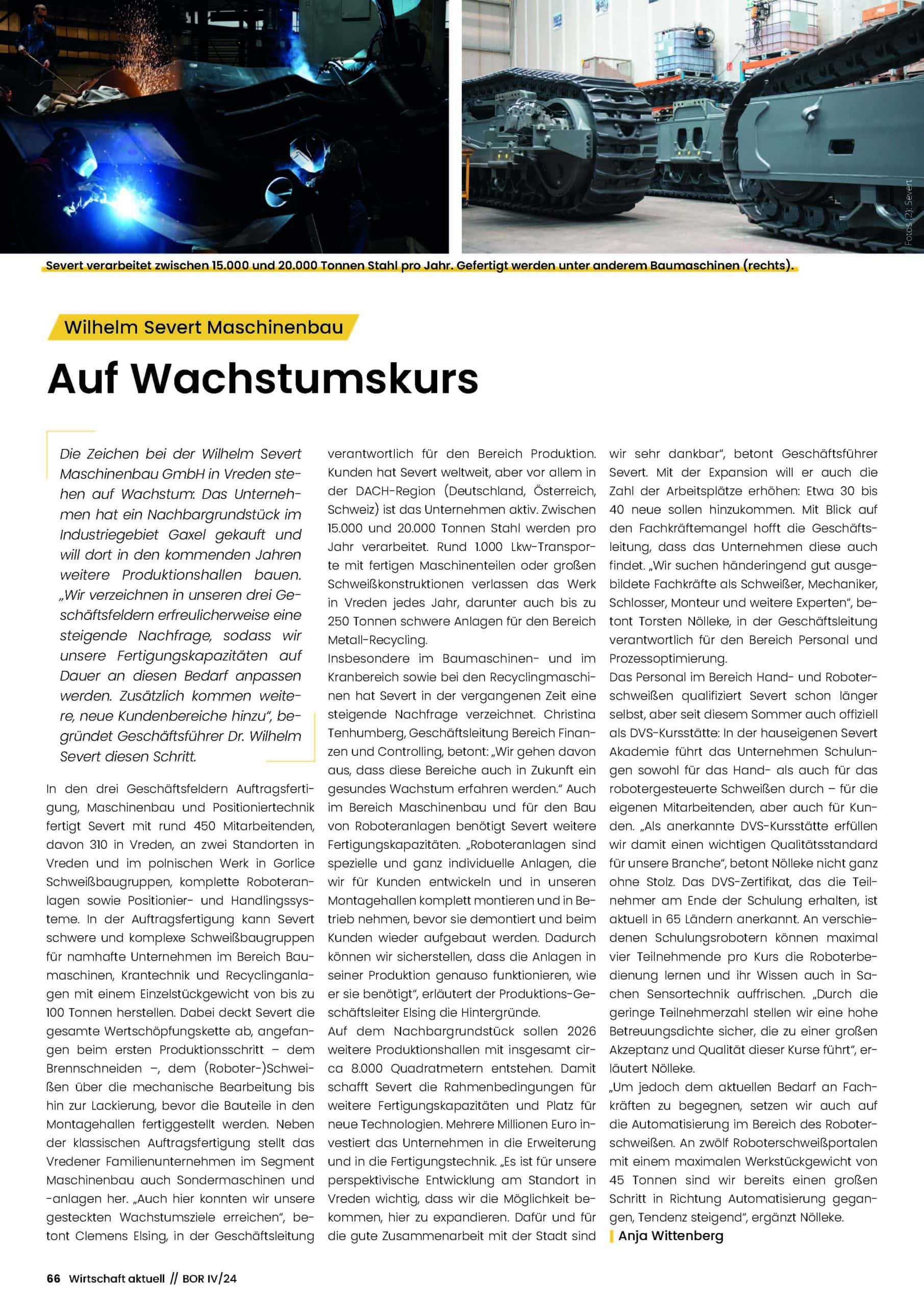
Wilhelm Severt Maschinenbau – On a Growth Path
The signs at Wilhelm Severt Maschinenbau GmbH in Vreden point toward growth: The company has acquired a neighboring property in the Gaxel industrial area and plans to build additional production halls there in the coming years.
“We are seeing increasing demand in our business areas, which means we need to continuously adapt our production capacities to this demand. In addition, new customer segments are emerging,” explains Managing Director Dr. Wilhelm Severt.
Across its three business divisions contract manufacturing, mechanical engineering, and positioning technology – Severt employs around 450 people, 310 of whom are based in Vreden. The company also operates two additional sites in Vreden and a facility in Gorlice, Poland.
Severt manufactures welded assemblies, complete robotic systems, as well as positioning and handling systems. In contract manufacturing, the company produces heavy and complex welded assemblies for well-known companies in sectors such as construction machinery, crane technology, and recycling plants, with individual component weights of up to 100 tons.
The company covers the entire value chain – from initial production steps such as flame cutting, to (robot-assisted) welding, mechanical processing, and painting, all the way to final assembly in its production halls.
In addition to traditional contract manufacturing, the Vreden-based family business also produces special-purpose machinery and systems. “We have also been able to achieve our targeted growth in this area,” emphasizes Clemens Elsing, who is responsible for production.
Severt serves customers worldwide, but primarily within the DACH region (Germany, Austria, Switzerland). Between 15,000 and 20,000 tons of steel are processed annually. Around 1,000 truckloads of finished machine parts or large welded structures leave the Vreden facility each year, including heavy systems weighing up to 250 tons for the metal recycling sector.
Particularly in the construction machinery and crane sectors, as well as in recycling systems, Severt has seen rising demand in recent years. Christina Tenhumberg, responsible for finance and controlling, explains: “We expect these areas to continue experiencing healthy growth in the future.” Additional production capacity is also needed in mechanical engineering and for the construction of robotic systems.
“Robotic systems are highly specialized and customized solutions that we develop for our customers and fully assemble in our facilities before dismantling and reassembling them at the customer’s site. This ensures that the systems function exactly as required in the customer’s production environment,” explains Production Manager Elsing.
By 2026, additional production halls with a total area of around 8,000 square meters are to be built on the neighboring property. This will create the conditions for further capacity expansion and space for new technologies. The company is investing several million euros in expanding its facilities and production technologies.
“For the future development of our site in Vreden, it is very important that we have the opportunity to expand here. We are very grateful for the good cooperation with the city,” emphasizes Managing Director Severt. The expansion will also increase the number of jobs, with around 30 to 40 new positions expected.
In view of the shortage of skilled workers, the management also hopes to address this challenge through training initiatives. “We are specifically training skilled workers such as welders, mechanics, metalworkers, assemblers, and other specialists,” explains Torsten Nölleke, who is responsible for HR and process optimization.
Severt has long been qualifying its employees in both manual and robotic welding and has been officially recognized as a DVS training center since this summer. In its in-house Severt Academy, the company offers training for both manual and robot-assisted welding – for its own employees as well as for customers.
“As a recognized DVS training center, we meet an important quality standard for our industry,” emphasizes Nölleke. The DVS certificate awarded to participants at the end of training is recognized in 65 countries. At various training robots, up to four participants per course can learn robot operation and refresh their knowledge of sensor technology.
“Thanks to the small group sizes, we ensure high training intensity, which leads to strong acceptance and high quality of these courses,” Nölleke explains.
To meet the current demand for skilled workers, the company is also increasingly focusing on automation in robotic welding. Twelve robotic welding portals with a maximum workpiece weight of 45 tons already represent a major step toward automation – and the trend is rising.
Author: Anja Wittenberg